DeepAgents
💡 This feature requires eino >= v0.5.14.
Overview
DeepAgents is an out-of-the-box solution built on ChatModelAgent. Without manually assembling prompts, tools, or context management, you can get an Agent with planning, file system, Shell execution, and sub-Agent delegation capabilities, while retaining all ChatModelAgent extension capabilities (custom tools, middleware, handlers).
Built-in Capabilities:
- Planning —
write_todostool for task decomposition and progress tracking - File System —
ls,read_file,write_file,edit_file,glob,grep - Shell —
execute(supports streaming) - Sub-Agent —
tasktool delegates tasks to context-isolated sub-agents - Smart Defaults — Built-in Prompt teaches the model to use tools efficiently
- Context Management — Large outputs are automatically saved to files
Import
import "github.com/cloudwego/eino/adk/prebuilt/deep"

agent, err := deep.New(ctx, &deep.Config{
    ChatModel: myModel,
})
Complete Config Definition
type Config = TypedConfig[*schema.Message]

type TypedConfig[M adk.MessageType] struct {
    Name        string              // Agent identifier name
    Description string              // Purpose description
    ChatModel   model.BaseModel[M]  // Required; must support model.WithTools
    Instruction string              // System prompt; uses built-in default Prompt when empty

    // Sub-Agents (bound to TaskTool)
    SubAgents []adk.TypedAgent[M]

    // Custom tools
    ToolsConfig  adk.ToolsConfig
    MaxIteration int // Maximum reasoning iteration count

    // File system (choose one or combine)
    Backend        filesystem.Backend        // Registers ls/read_file/write_file/edit_file/glob/grep
    Shell          filesystem.Shell          // Registers execute (mutually exclusive with StreamingShell)
    StreamingShell filesystem.StreamingShell  // Registers execute (streaming, mutually exclusive with Shell)

    // Built-in feature toggles
    WithoutWriteTodos      bool // true disables the write_todos tool
    WithoutGeneralSubAgent bool // true disables the default general-purpose sub-Agent

    // TaskTool description generator (customize the task tool's description)
    TaskToolDescriptionGenerator func(ctx context.Context, agents []adk.TypedAgent[M]) (string, error)

    // Extensions
    Middlewares []adk.AgentMiddleware                   // struct-based middleware
    Handlers    []adk.TypedChatModelAgentMiddleware[M]  // interface-based handlers

    // Model fault tolerance
    ModelRetryConfig    *adk.TypedModelRetryConfig[M]
    ModelFailoverConfig *adk.ModelFailoverConfig[M]

    // Output storage (written to session via AddSessionValue)
    OutputKey string
}
Constructor
// Standard version (M = *schema.Message)
func New(ctx context.Context, cfg *Config) (adk.ResumableAgent, error)

// Generic version (supports *schema.AgenticMessage)
func NewTyped[M adk.MessageType](ctx context.Context, cfg *TypedConfig[M]) (adk.TypedResumableAgent[M], error)
💡 Returns ResumableAgent (includes Resume method), which can be used with Runner’s checkpoint/resume mechanism.
Architecture
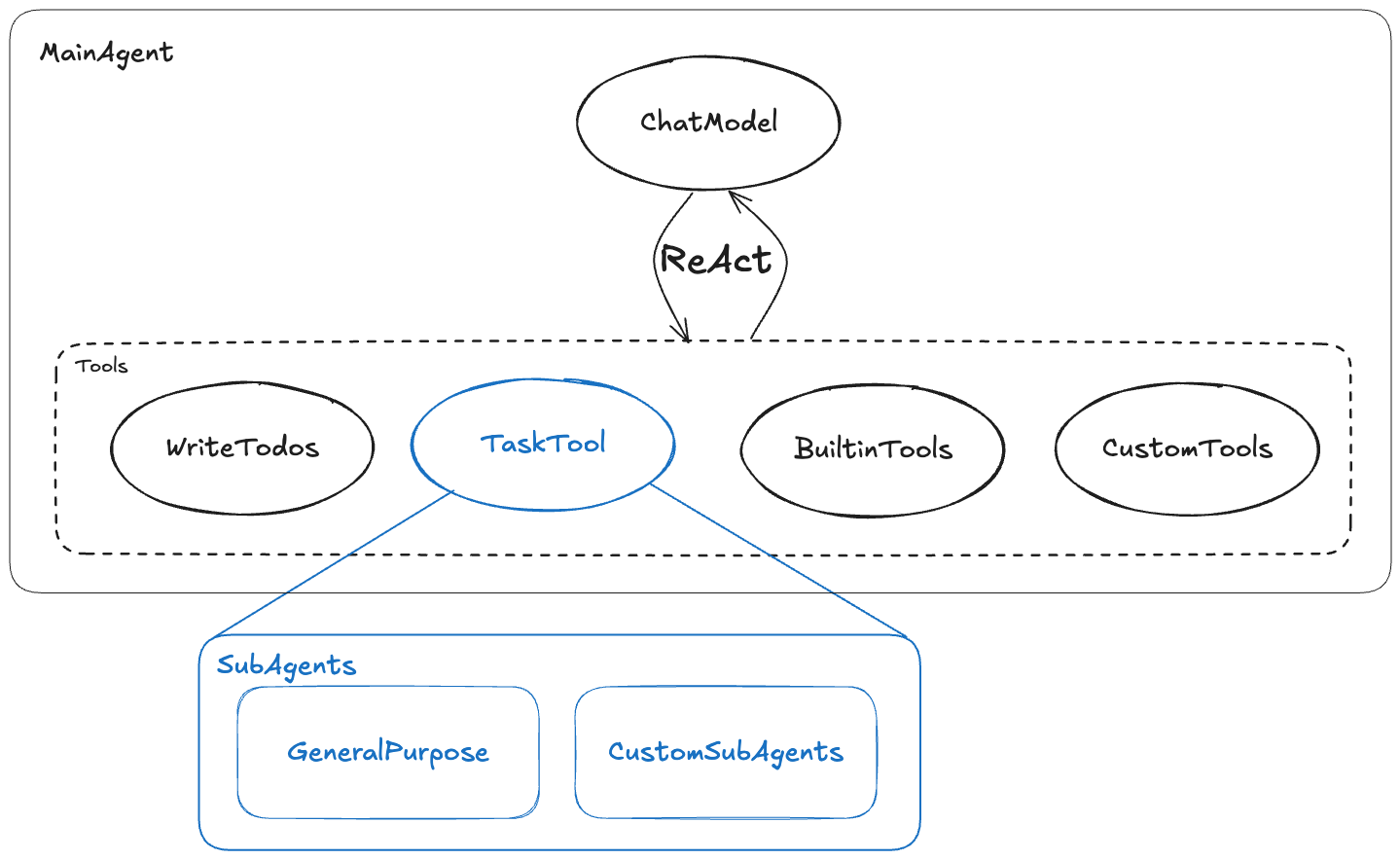
- Main Agent: System entry point, completes tasks by calling tools in ReAct mode
- ChatModel (
model.BaseModel[M]): Responsible for reasoning and tool selection - Tools:
write_todos: Built-in planning tool that decomposes tasks into a structured TODO listtask: Unified entry point for sub-Agent invocation (routing parameters:subagent_type,description)- Built-in tools (file system/Shell) + user-defined tools (
ToolsConfig)
- SubAgents: Context-isolated, independently execute subtasks
general-purpose: Default sub-Agent, has the same tools (except task) and configuration as the main Agent- Custom sub-Agents (
Config.SubAgents)
Built-in File System
| Config Field | Registered Tools | Description |
Backend | ls, read_file, write_file, edit_file, glob, grep | File system operations |
Shell | execute | Non-streaming command execution, mutually exclusive with StreamingShell |
StreamingShell | execute (streaming) | Streaming command execution, mutually exclusive with Shell |
Internally implemented using the FileSystem Middleware.
Task Planning: write_todos
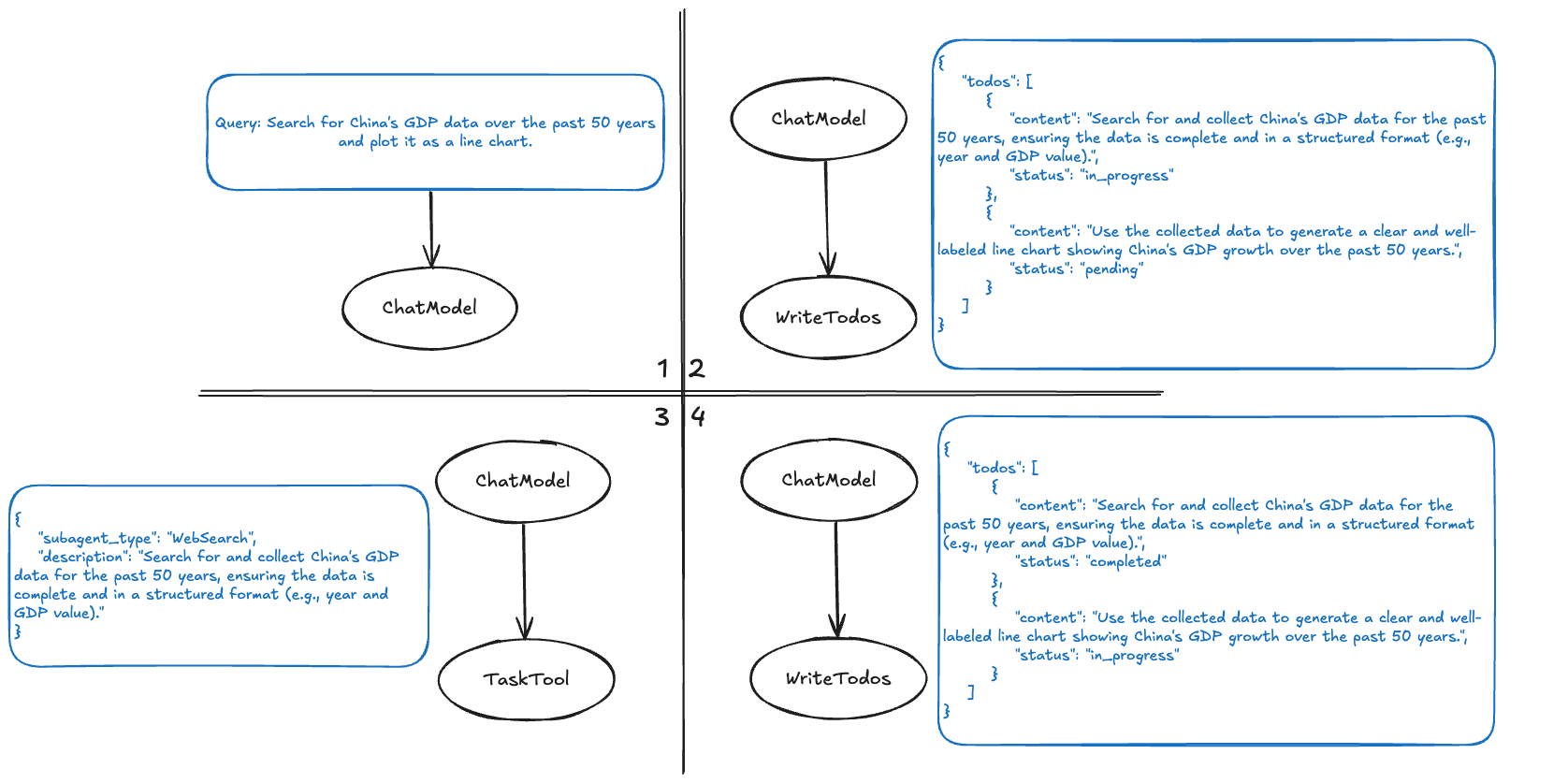
The write_todos tool writes a structured TODO list to the session (key: deep_agent_session_key_todos) for reference in subsequent reasoning.
TODO Structure:
type TODO struct {
    Content    string `json:"content"`
    ActiveForm string `json:"activeForm"`
    Status     string `json:"status"` // "pending" | "in_progress" | "completed"
}
Workflow:
- The model receives user input
- Calls
write_todosto decompose tasks and write them to context - Executes TODO items one by one (via task or direct tools)
- Calls
write_todosagain to update progress
💡 For simple tasks, calling write_todos every time may be counterproductive. The built-in Prompt includes positive and negative examples to guide when to use it. You can further tune this with a custom Instruction. Set WithoutWriteTodos=true to disable it entirely.
Sub-Agent Delegation: task Tool
TaskTool is the unified invocation entry point for all sub-Agents:
- Parameters:
subagent_type(target sub-Agent name),description(task description) - Internally wraps each sub-Agent as a tool via
adk.NewTypedAgentTool - Default Description includes the names and descriptions of all available sub-Agents; customizable via
TaskToolDescriptionGenerator
Context Isolation:
- Sub-Agents only receive the task description assigned by the main Agent, without sharing conversation history
- The main Agent only receives the sub-Agent’s final result; intermediate steps are not passed back
- Prevents large volumes of tool calls and intermediate reasoning from “polluting” the main Agent’s context
general-purpose Sub-Agent:
- Created by default, with the same tools (except task), Instruction, and ModelFailoverConfig as the main Agent
- Used to execute general tasks in an isolated context when no specialized sub-Agent is available
- Set
WithoutGeneralSubAgent=trueto disable
Comparison with Other Solutions
| Dimension | DeepAgents vs ReAct | DeepAgents vs Plan-and-Execute |
| Advantages | Built-in planning + sub-Agent context isolation, better performance on multi-step tasks | Plan/RePlan invoked as tools on demand, reducing unnecessary planning overhead |
| Disadvantages | Planning + sub-Agent invocation increases model requests, latency, and token cost | Planning and delegation completed in a single call, requires higher model capability |
Usage Example
Excel Agent Scenario
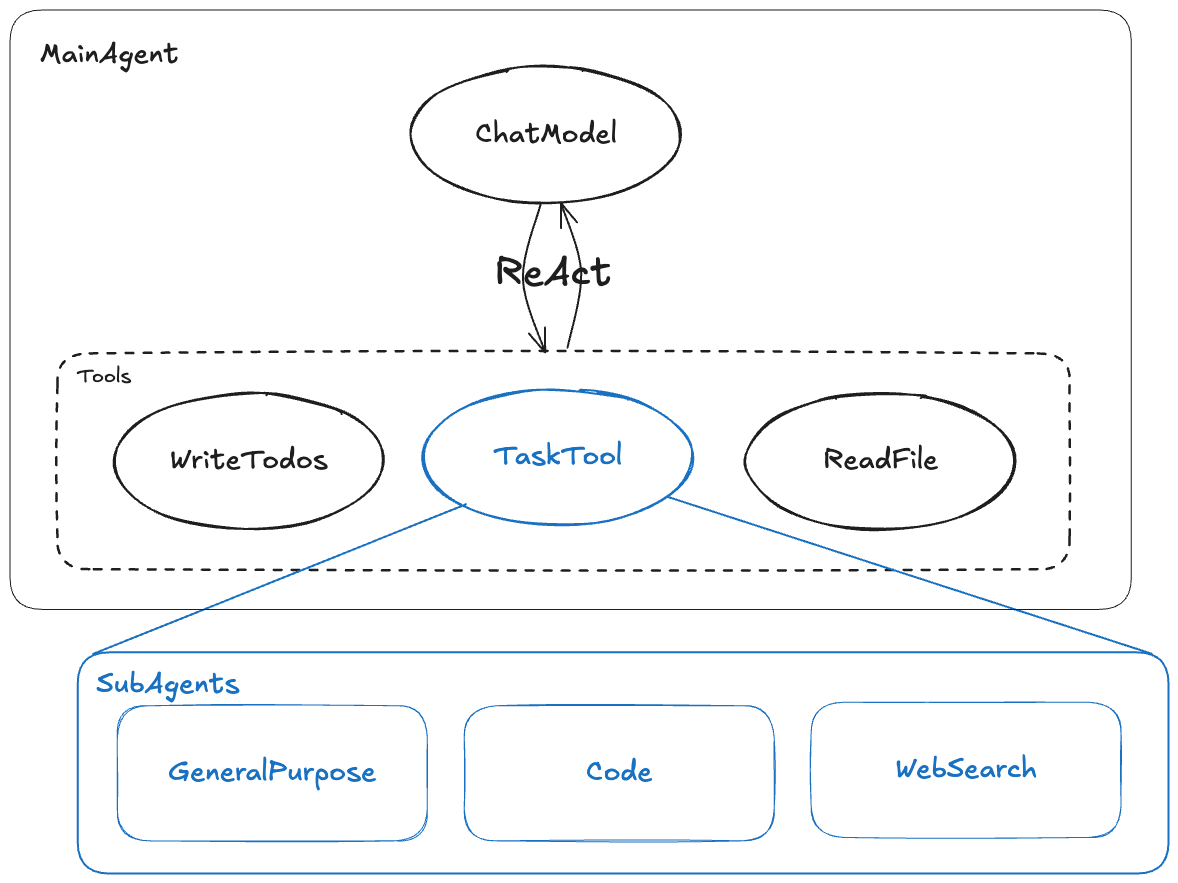
- The main Agent is configured with a ReadFile tool to assist in task formulation
- Two sub-Agents are added: Code (Python for Excel operations) and WebSearch
Code
Full example: https://github.com/cloudwego/eino-examples/tree/main/adk/multiagent/deep
agent, err := deep.New(ctx, &deep.Config{
    Name:      "ExcelAgent",
    ChatModel: myModel,
    Backend:   localBackend,
    SubAgents: []adk.Agent{codeAgent, webSearchAgent},
    ToolsConfig: adk.ToolsConfig{
        InvokableTools: []tool.InvokableTool{readFileTool},
    },
})